Today, a low pressure system is pushing through northern New York and New England. It's a relatively classic apostrophe-shaped mid-latitude storm system.
However, warning were just issued for an area just northwest of us to expect 4-7 inches of rain from this storm as a result of heavy downpours from the passage of a train of thunderstorms. This is a remarkable amount of rain to come out of such a system, from a historical perspective. The 24-hour rainfall record at Reading is about 8.5 inches, set during the landfall of Hurricane Agnes in 1972. It is conceivable that some localities in this region may set new single-day rainfall records today. And eastern Pennsylvania is not alone in its experience of this storm. The storm totals (see below), as of 3 pm today, exceed 6" in parts of North Carolina and exceed 4" in wide areas of North Carolina and Kentucky and some additional rain is possible in those areas.
Several flash flood and flood warnings have been issued for our region and stream and river hydrographs are rising very rapidly. No major flooding is expected, thankfully, but there is clearly a lot of moisture in this system.
The occurrence of more frequent, more extreme rainfall events is the flip side of the occurrence of more frequent more extreme droughts, as both are driven by a warming atmosphere. As Earth warms, more liquid water can evaporate into the atmosphere. As the low pressure system forms, and air is drawn in and cooled, the balance between evaporation and condensation shifts and condensation increases, eventually resulting in rain. Since there is more vapor available, more rainfall can occur (thanks to the Bad Meteorology blog for helping me get this straight). Hurricanes are famous for their ability to delivering drenching rainfall in large part because they collect water vapor into their circulating air over very warm tropical seas. As temperatures increase everywhere, we should expect more non-tropical systems to deliver deluges and this is in fact what climate modelers have been predicting to come from a warming world. All of which leads me back to the title question... Is this just a singular isolated event, or is this now the weather we can expect on a regular basis, the new normal?
A chaotic and structurally complex geologic formation containing large and small fragments of uncertain heritage
Tuesday, September 18, 2012
Sunday, August 26, 2012
Earthquake Swarm near Brawley, CA
This afternoon, in the course of a few hours, dozens of earthquakes shook the area around Brawley, CA along the southeastern side of the Salton Sea. The largest of these quakes had a moment magnitude of 5.5 and a Mercalli Intensity at the epicenter of VII. Below is a map and a partial list of the larger quakes, from the USGS.
On this map, the two darkest red traces, are the traces of the San Andreas fault. If you were to walk along either strand, toward the other, you would have to make a big step to the right, right at Brawley.
Because the San Andreas fault is a right-lateral strike slip fault, the western portion of this map is moving to the northwest and the eastern portion of this map is moving to the southeast, relative to each other. This means that the crust at this stepover is tending to have a big hole ripped in it. Since we cannot rip big holes in the crust, the crust instead stretches to fill in the gap. In the upper crust it does this by forming normal faults. The predicted orientation of these normal faults is about 120 degrees away from the trace of the San Andreas fault. Interestingly, the orientation of the swarm at Brawley is more nearly perpendicular to the San Andreas trend, as is the trend of topographic features in the area, suggesting this is a long-lived fault orientation. Update (8/27/12) The centroid moment tensor solution http://earthquake.usgs.gov/earthquakes/eqarchives/gcmt/neic_c000c7i2_gcmt.php shows that the largest of these quakes moved with slightly oblique strike-slip motion on either a right-lateral fault paralleling the San Andreas trend or a left-lateral fault perpendicular to it.
In this area, the Salton Sea owes its existence to these normal faults and to the stretching of the crust. The stretching occurring at this stepover is producing a depression, the Salton Sink, which filled with water when a 1905 flood overwhelmed a newly-constructed irrigation canal and diverted water from the Colorado River into the depression. The diverted waters rapidly eroded the soft soils in the area, creating new river channels. The flooding of the Salton Sink went on for two years before finally being stopped, leaving the large puddle of water we now call the Salton Sea.
Earthquake swarms are distinctive in that they have several to many quakes of similar magnitude along a fault system, as opposed to the more common pattern of a single large mainshock followed by many smaller aftershocks. There are many reasons that have been suggested, including effects of fluid or magmatic pressures. There are no active volcanoes at Brawley, so we can rule out volcanic mechanisms, but it is possible that some sort of hydrothermal or other fluid flow played a role.
On this map, the two darkest red traces, are the traces of the San Andreas fault. If you were to walk along either strand, toward the other, you would have to make a big step to the right, right at Brawley.
Because the San Andreas fault is a right-lateral strike slip fault, the western portion of this map is moving to the northwest and the eastern portion of this map is moving to the southeast, relative to each other. This means that the crust at this stepover is tending to have a big hole ripped in it. Since we cannot rip big holes in the crust, the crust instead stretches to fill in the gap. In the upper crust it does this by forming normal faults. The predicted orientation of these normal faults is about 120 degrees away from the trace of the San Andreas fault. Interestingly, the orientation of the swarm at Brawley is more nearly perpendicular to the San Andreas trend, as is the trend of topographic features in the area, suggesting this is a long-lived fault orientation. Update (8/27/12) The centroid moment tensor solution http://earthquake.usgs.gov/earthquakes/eqarchives/gcmt/neic_c000c7i2_gcmt.php shows that the largest of these quakes moved with slightly oblique strike-slip motion on either a right-lateral fault paralleling the San Andreas trend or a left-lateral fault perpendicular to it.
In this area, the Salton Sea owes its existence to these normal faults and to the stretching of the crust. The stretching occurring at this stepover is producing a depression, the Salton Sink, which filled with water when a 1905 flood overwhelmed a newly-constructed irrigation canal and diverted water from the Colorado River into the depression. The diverted waters rapidly eroded the soft soils in the area, creating new river channels. The flooding of the Salton Sink went on for two years before finally being stopped, leaving the large puddle of water we now call the Salton Sea.
Earthquake swarms are distinctive in that they have several to many quakes of similar magnitude along a fault system, as opposed to the more common pattern of a single large mainshock followed by many smaller aftershocks. There are many reasons that have been suggested, including effects of fluid or magmatic pressures. There are no active volcanoes at Brawley, so we can rule out volcanic mechanisms, but it is possible that some sort of hydrothermal or other fluid flow played a role.
Monday, May 2, 2011
Change in my work email
Hi,
My work email is changing. It is now david@davincisciencecenter.org Please update your records accordingly. While you are at it, why not check out our new website at www.davincisciencecenter.org?
Thanks,
Dave Smith
My work email is changing. It is now david@davincisciencecenter.org Please update your records accordingly. While you are at it, why not check out our new website at www.davincisciencecenter.org?
Thanks,
Dave Smith
Thursday, February 3, 2011
The Arctic would like its winter back
1. Weather does not equal climate
2. The United States does not equal the world.
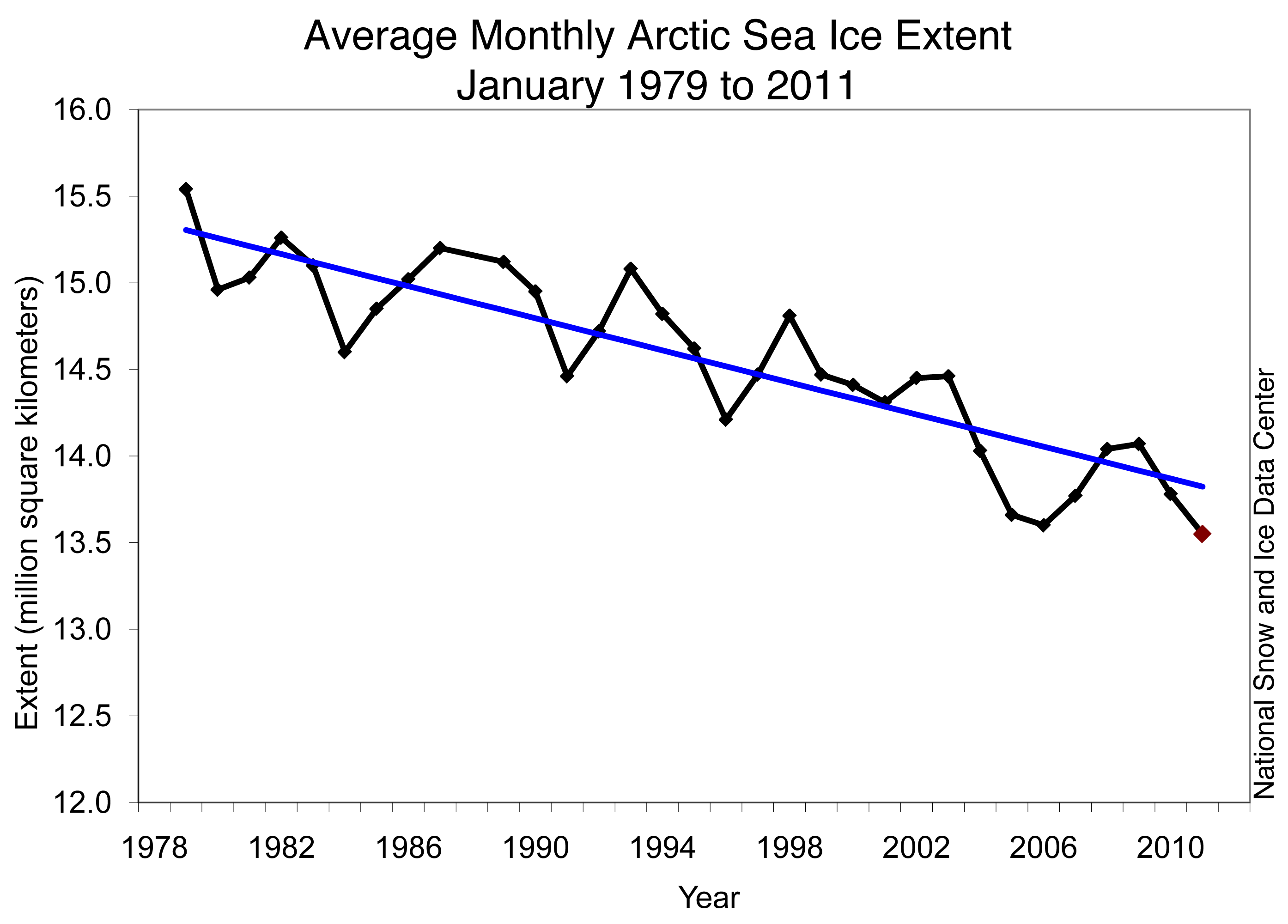
Although we have had unusually cold winter weather over much of the lower 48 states this year, the Arctic has been having yet more unusually warm weather. One piece of evidence is the record low extent of Arctic sea ice. The graph above shows the decline in the average annual extent. To be sure, the Arctic melt-off is much more severe in summer than in winter and these data points are year-long averages that incorporate summer extent, but there is still a clear trend consistent with significant warming of the Arctic.
This winter's weather in the Eastern US is most likely due to the North Atlantic Oscillation - a periodic rearrangement of the dominant weather systems - high latitude high pressure and mid-latitude low pressure - that changes the storm tracks across the northeastern United States and parts of Europe as well. The NAO is similar to its cousin ENSO, the El Nino Southern Oscillation. It seems to be that El Nino and NAO are not linked, although both have profound hemispheric, even global, impacts. Although the deeper causes of the NAO are not yet well understood, there is growing understanding of how to predict it and what the resulting effects on the local weather will be. What is also not known is the extent to which additions of fossil fuel carbon dioxide and the resulting warming may create a feedback with the NAO. Although we are currently in a negative NAO, it has been unusually positive for most of the past two decades, which is intriguing but certainly not definitive. See Professor David Stephenson's NAO page http://www1.secam.ex.ac.uk/cat/NAO for more detailed description and history.
Tuesday, December 14, 2010
What Happens When the Science Really IS Shaky
The scientific findings indicating that anthropogenic climate change is occurring at an increasing rate, with far-reaching consequences are about as robust as science ever gets. Nevertheless, they are under ceaseless and increasingly aggressive political attack. So, how can one tell if a scientific idea has any merit in the face of all this political grandstanding?
It's quite simple, really. Sit back for a short time and watch other scientists react to it.
Two weeks ago, NASA scientists published a paper in Science, http://www.sciencemag.org/content/early/2010/12/01/science.1197258 presenting evidence that arsenic could replace phosphorus in at least one species of living organism, an extremophile bacterium in Mono Lake, CA. This would be, if true, a Really. Big. Deal. So people read the paper. Very. Carefully. In less than a week, scientists have come pouring out of the woodwork, discrediting the research findings and techniques used in the paper. See http://rrresearch.blogspot.com/2010/12/arsenic-associated-bacteria-nasas.html and the comments therein for one example of the critique. At the very least, there remains a great deal of more careful data collection to be done before any sort of confidence can be assigned to these findings.
This is exactly the sort of response that scientists expect and desire, but with the spread of the blogosphere, it is now much more public than it ever has been, which means that even casual readers can see the testing of scientific ideas in action. If you believe that scientists tend to stick up for each other in some kind of secret society, take another look at those comments on RRResearch - it's a feeding frenzy. This feeding frenzy is not an aberration, either. This is how scientists talk to each other, even scientists who fundamentally respect each other.
When ordinary people think someone they know and like has made an error, they may elect to keep it to themselves to protect the relationship. People don't generally go to a dinner party where the chicken soup is too salty and say to the host, "You know, I've reviewed your technique and you clearly forget to account for the effect of increasing concentration due to evaporation losses." But, in science that is exactly what scientists do to each other. Unchallenged mistakes are a big problem so it is best to shed light on the problem immediately. Ideally, this happens pre-publication, in the peer-review process. However, no system of review is foolproof and editors may also opt to publish something they think is important, even in the face of reviewer's objections. It's not yet clear what happened during the publication of the NASA results, but it should be clear in the aftermath that poor science, once exposed to the view of the scientific community, does not stand for long.
Big news in science, just as in other fields, can get a lot of media hype and that hype may or may not be justified in the end. Ditto for political attention. If you want to know if the science is any good, however, don't pay any attention to the media or the politicos. Instead, pay attention to the scientists.
It's quite simple, really. Sit back for a short time and watch other scientists react to it.
Two weeks ago, NASA scientists published a paper in Science, http://www.sciencemag.org/content/early/2010/12/01/science.1197258 presenting evidence that arsenic could replace phosphorus in at least one species of living organism, an extremophile bacterium in Mono Lake, CA. This would be, if true, a Really. Big. Deal. So people read the paper. Very. Carefully. In less than a week, scientists have come pouring out of the woodwork, discrediting the research findings and techniques used in the paper. See http://rrresearch.blogspot.com/2010/12/arsenic-associated-bacteria-nasas.html and the comments therein for one example of the critique. At the very least, there remains a great deal of more careful data collection to be done before any sort of confidence can be assigned to these findings.
This is exactly the sort of response that scientists expect and desire, but with the spread of the blogosphere, it is now much more public than it ever has been, which means that even casual readers can see the testing of scientific ideas in action. If you believe that scientists tend to stick up for each other in some kind of secret society, take another look at those comments on RRResearch - it's a feeding frenzy. This feeding frenzy is not an aberration, either. This is how scientists talk to each other, even scientists who fundamentally respect each other.
When ordinary people think someone they know and like has made an error, they may elect to keep it to themselves to protect the relationship. People don't generally go to a dinner party where the chicken soup is too salty and say to the host, "You know, I've reviewed your technique and you clearly forget to account for the effect of increasing concentration due to evaporation losses." But, in science that is exactly what scientists do to each other. Unchallenged mistakes are a big problem so it is best to shed light on the problem immediately. Ideally, this happens pre-publication, in the peer-review process. However, no system of review is foolproof and editors may also opt to publish something they think is important, even in the face of reviewer's objections. It's not yet clear what happened during the publication of the NASA results, but it should be clear in the aftermath that poor science, once exposed to the view of the scientific community, does not stand for long.
Big news in science, just as in other fields, can get a lot of media hype and that hype may or may not be justified in the end. Ditto for political attention. If you want to know if the science is any good, however, don't pay any attention to the media or the politicos. Instead, pay attention to the scientists.
Friday, May 14, 2010
The True Face of Scientific Dissent
We hear a lot about how scientists are supposedly squelching dissent on issues such as evolution and climate change. This is nonsense, but it might be helpful to have a case study of how accespting science is to dissenting views, as long as they are presented in the form of scientific arguments - novel explanations that are supported by data and analysis.
The March 2010 issue of Reviews of Geophysics just arrived in my mailbox. In this issue is a paper by Kutcherov and Krayushkin on "Deep-Seated Abiogenic Origin of Petroleum: From Geologic Assessment to Physical Theory." Most petroleum geologists, reject this idea and instead accept the biogenic theory (petroleum is derived from the thermal breakdown of fatty material in the remains of dead single-celled organisms in oxygen-poor sediments.) Not only that, but the abiogenic hypothesis posits that petroleum is super-abundant and that we could find it anywhere. If this were true it could case a global crash in petroleum prices, which depend on a belief in scarcity. There is a powerful incentive to suppress this hypothesis in favor of the current dogma, especially by Western petroleum geologists, most of whom work for petroleum companies. So how did this article get published?
It's very simple, they wrote it and submitted it, but most importantly, they generated evidence and the editors could not find any substantive problems with their data. These authors create a case, documenting the production of hydrocarbons from the reduction of carbonates at mantle temperatures and pressures. These experiments were not easy to do, but they document a methodology that is reasonable and they provide results that match natural petroleum profiles in at least a few cases.
This paper may well be wrong. In fact, it still seems very unlikely that most of the petroleum we extract came from anything other than dead organisms. However, the editors of the journal not only published the paper, they celebrated it, by putting two of the authors' illustrations on the front cover of this issue. That's because, whether they are ultimately right or not, the authors have produced an important new body of data that should cause everyone to re-examine the existing data and their ideas on the subject.
The truth of the matter is that novel scientific ideas, no matter how far-fetched or anti-orthodox they are, usually get more press than the accepted idea, not less, provided that they are scientific ideas, based in data and supported by analysis. The next time someone tells you that a scientific alternative is being suppressed by scientists, ask to see their data and their analysis. It is very likely that the alternative is not so scientific, after all. Otherwise, it would probably be on the front cover of some journal somewhere.
The March 2010 issue of Reviews of Geophysics just arrived in my mailbox. In this issue is a paper by Kutcherov and Krayushkin on "Deep-Seated Abiogenic Origin of Petroleum: From Geologic Assessment to Physical Theory." Most petroleum geologists, reject this idea and instead accept the biogenic theory (petroleum is derived from the thermal breakdown of fatty material in the remains of dead single-celled organisms in oxygen-poor sediments.) Not only that, but the abiogenic hypothesis posits that petroleum is super-abundant and that we could find it anywhere. If this were true it could case a global crash in petroleum prices, which depend on a belief in scarcity. There is a powerful incentive to suppress this hypothesis in favor of the current dogma, especially by Western petroleum geologists, most of whom work for petroleum companies. So how did this article get published?
It's very simple, they wrote it and submitted it, but most importantly, they generated evidence and the editors could not find any substantive problems with their data. These authors create a case, documenting the production of hydrocarbons from the reduction of carbonates at mantle temperatures and pressures. These experiments were not easy to do, but they document a methodology that is reasonable and they provide results that match natural petroleum profiles in at least a few cases.
This paper may well be wrong. In fact, it still seems very unlikely that most of the petroleum we extract came from anything other than dead organisms. However, the editors of the journal not only published the paper, they celebrated it, by putting two of the authors' illustrations on the front cover of this issue. That's because, whether they are ultimately right or not, the authors have produced an important new body of data that should cause everyone to re-examine the existing data and their ideas on the subject.
The truth of the matter is that novel scientific ideas, no matter how far-fetched or anti-orthodox they are, usually get more press than the accepted idea, not less, provided that they are scientific ideas, based in data and supported by analysis. The next time someone tells you that a scientific alternative is being suppressed by scientists, ask to see their data and their analysis. It is very likely that the alternative is not so scientific, after all. Otherwise, it would probably be on the front cover of some journal somewhere.
The Death of Disciplinarity
New work, funded by the National Science Foundation, provides more evidence that traditional disciplinary boundaries in the sciences have become essentially meaningless.
Biology, chemistry, physics, and engineering have effectively ceased to exist as separate disciplines. How long will it take our schools and colleges to recognize that and respond? Will it be fast enough?
- Robots that have no circuity and no motors
- Programs that are written in DNA molecules, not a computer language
- Chemical reactions that create engineered structures
Biology, chemistry, physics, and engineering have effectively ceased to exist as separate disciplines. How long will it take our schools and colleges to recognize that and respond? Will it be fast enough?
Subscribe to:
Posts (Atom)