Thursday, February 3, 2011

The Arctic would like its winter back

As we shiver here in the Northeast, it is common to hear comments that embed two major misconceptions - comments like "whatever happened to global warming?" There are two things wrong with these statements:

1. Weather does not equal climate

2. The United States does not equal the world.

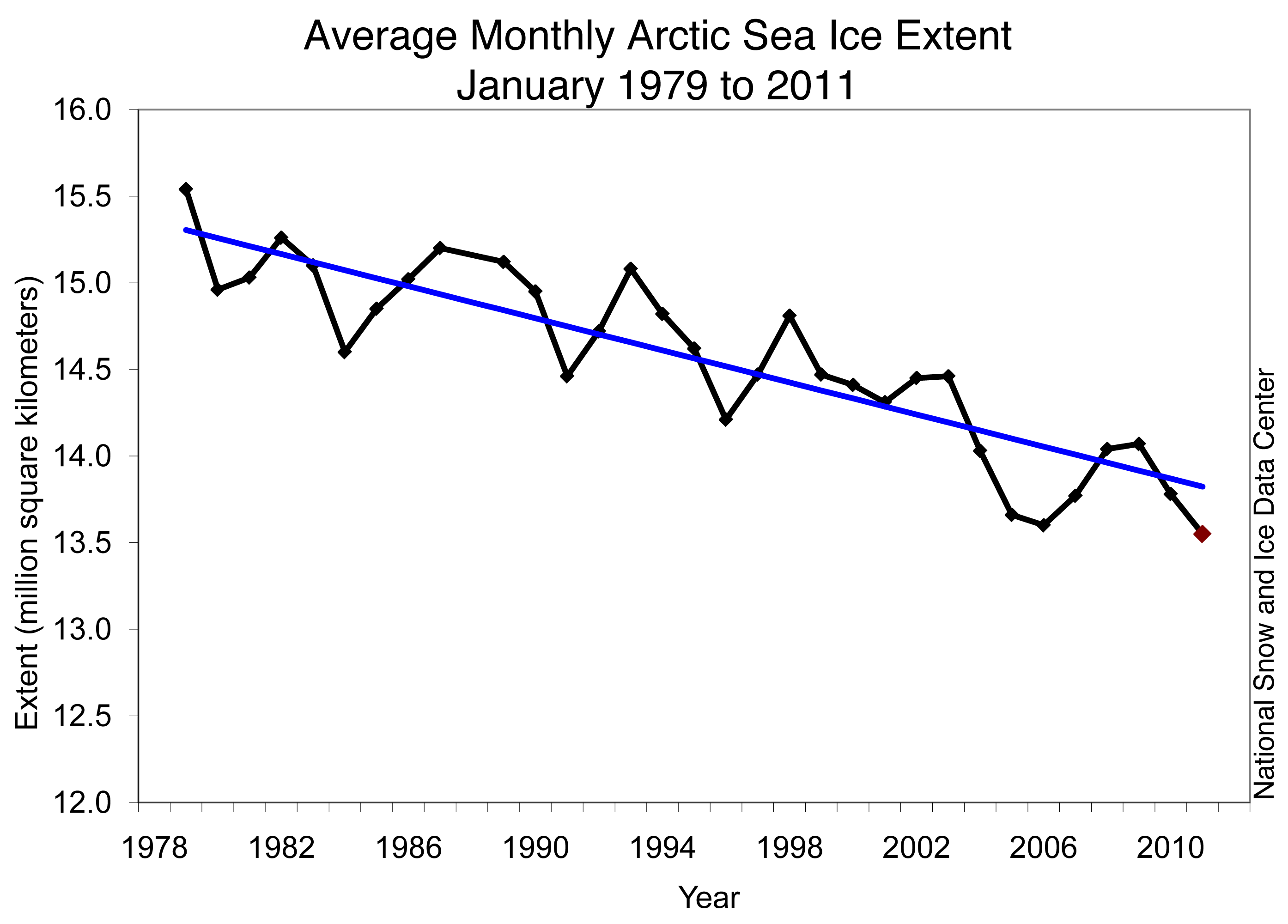
Although we have had unusually cold winter weather over much of the lower 48 states this year, the Arctic has been having yet more unusually warm weather. One piece of evidence is the record low extent of Arctic sea ice. The graph above shows the decline in the average annual extent. To be sure, the Arctic melt-off is much more severe in summer than in winter and these data points are year-long averages that incorporate summer extent, but there is still a clear trend consistent with significant warming of the Arctic.

This winter's weather in the Eastern US is most likely due to the North Atlantic Oscillation - a periodic rearrangement of the dominant weather systems - high latitude high pressure and mid-latitude low pressure - that changes the storm tracks across the northeastern United States and parts of Europe as well. The NAO is similar to its cousin ENSO, the El Nino Southern Oscillation. It seems to be that El Nino and NAO are not linked, although both have profound hemispheric, even global, impacts. Although the deeper causes of the NAO are not yet well understood, there is growing understanding of how to predict it and what the resulting effects on the local weather will be. What is also not known is the extent to which additions of fossil fuel carbon dioxide and the resulting warming may create a feedback with the NAO. Although we are currently in a negative NAO, it has been unusually positive for most of the past two decades, which is intriguing but certainly not definitive. See Professor David Stephenson's NAO page http://www1.secam.ex.ac.uk/cat/NAO for more detailed description and history.

Tuesday, December 14, 2010

What Happens When the Science Really IS Shaky

The scientific findings indicating that anthropogenic climate change is occurring at an increasing rate, with far-reaching consequences are about as robust as science ever gets. Nevertheless, they are under ceaseless and increasingly aggressive political attack. So, how can one tell if a scientific idea has any merit in the face of all this political grandstanding?

It's quite simple, really. Sit back for a short time and watch other scientists react to it.

Two weeks ago, NASA scientists published a paper in Science, http://www.sciencemag.org/content/early/2010/12/01/science.1197258 presenting evidence that arsenic could replace phosphorus in at least one species of living organism, an extremophile bacterium in Mono Lake, CA. This would be, if true, a Really. Big. Deal. So people read the paper. Very. Carefully. In less than a week, scientists have come pouring out of the woodwork, discrediting the research findings and techniques used in the paper. See http://rrresearch.blogspot.com/2010/12/arsenic-associated-bacteria-nasas.html and the comments therein for one example of the critique. At the very least, there remains a great deal of more careful data collection to be done before any sort of confidence can be assigned to these findings.

This is exactly the sort of response that scientists expect and desire, but with the spread of the blogosphere, it is now much more public than it ever has been, which means that even casual readers can see the testing of scientific ideas in action. If you believe that scientists tend to stick up for each other in some kind of secret society, take another look at those comments on RRResearch - it's a feeding frenzy. This feeding frenzy is not an aberration, either. This is how scientists talk to each other, even scientists who fundamentally respect each other.

When ordinary people think someone they know and like has made an error, they may elect to keep it to themselves to protect the relationship. People don't generally go to a dinner party where the chicken soup is too salty and say to the host, "You know, I've reviewed your technique and you clearly forget to account for the effect of increasing concentration due to evaporation losses." But, in science that is exactly what scientists do to each other. Unchallenged mistakes are a big problem so it is best to shed light on the problem immediately. Ideally, this happens pre-publication, in the peer-review process. However, no system of review is foolproof and editors may also opt to publish something they think is important, even in the face of reviewer's objections. It's not yet clear what happened during the publication of the NASA results, but it should be clear in the aftermath that poor science, once exposed to the view of the scientific community, does not stand for long.

Big news in science, just as in other fields, can get a lot of media hype and that hype may or may not be justified in the end. Ditto for political attention. If you want to know if the science is any good, however, don't pay any attention to the media or the politicos. Instead, pay attention to the scientists.

Friday, May 14, 2010

The True Face of Scientific Dissent

We hear a lot about how scientists are supposedly squelching dissent on issues such as evolution and climate change. This is nonsense, but it might be helpful to have a case study of how accespting science is to dissenting views, as long as they are presented in the form of scientific arguments - novel explanations that are supported by data and analysis.

The March 2010 issue of Reviews of Geophysics just arrived in my mailbox. In this issue is a paper by Kutcherov and Krayushkin on "Deep-Seated Abiogenic Origin of Petroleum: From Geologic Assessment to Physical Theory." Most petroleum geologists, reject this idea and instead accept the biogenic theory (petroleum is derived from the thermal breakdown of fatty material in the remains of dead single-celled organisms in oxygen-poor sediments.) Not only that, but the abiogenic hypothesis posits that petroleum is super-abundant and that we could find it anywhere. If this were true it could case a global crash in petroleum prices, which depend on a belief in scarcity. There is a powerful incentive to suppress this hypothesis in favor of the current dogma, especially by Western petroleum geologists, most of whom work for petroleum companies. So how did this article get published?

It's very simple, they wrote it and submitted it, but most importantly, they generated evidence and the editors could not find any substantive problems with their data. These authors create a case, documenting the production of hydrocarbons from the reduction of carbonates at mantle temperatures and pressures. These experiments were not easy to do, but they document a methodology that is reasonable and they provide results that match natural petroleum profiles in at least a few cases.

This paper may well be wrong. In fact, it still seems very unlikely that most of the petroleum we extract came from anything other than dead organisms. However, the editors of the journal not only published the paper, they celebrated it, by putting two of the authors' illustrations on the front cover of this issue. That's because, whether they are ultimately right or not, the authors have produced an important new body of data that should cause everyone to re-examine the existing data and their ideas on the subject.

The truth of the matter is that novel scientific ideas, no matter how far-fetched or anti-orthodox they are, usually get more press than the accepted idea, not less, provided that they are scientific ideas, based in data and supported by analysis. The next time someone tells you that a scientific alternative is being suppressed by scientists, ask to see their data and their analysis. It is very likely that the alternative is not so scientific, after all. Otherwise, it would probably be on the front cover of some journal somewhere.

The Death of Disciplinarity

New work, funded by the National Science Foundation, provides more evidence that traditional disciplinary boundaries in the sciences have become essentially meaningless.
  • Robots that have no circuity and no motors
  • Programs that are written in DNA molecules, not a computer language
  • Chemical reactions that create engineered structures

Biology, chemistry, physics, and engineering have effectively ceased to exist as separate disciplines. How long will it take our schools and colleges to recognize that and respond? Will it be fast enough?

Wednesday, April 7, 2010

Flood Forums coming to Easton and Allentown in April

Many people know about floods on the Delaware River, but did you know floods have resulted in more than $3 million in flood insurance payments in Allentown in the last 35 years?

From our partner, Kate Brandes, at the Nurture Nature Foundation in downtown Easton comes the following announcement:

Nurture Nature Foundation is excited to announce upcoming community forums on flooding in Eastonand Allentown. NNF is developing a science center about flooding. We’re asking people who work and live in Easton and Allentown to share thoughts and concerns about flooding, streams, and rivers in their community. The purpose of the “Flood Forums” is to:
1) Provide feedback from community members to decision makers, and
2) Gather ideas for our developing science center on flooding
Flood forums will be held in Easton on April 18 and April 21. In Allentown, forums will be on April 19 and 20. Please see the flyers for times and locations. All participants will receive $30. You must pre-register for the events.
Please contact Kate Brandes at 610-253-4432 or kbrandes@nurturenature.org if you are interested in participating or if you have questions.
This project is being supported by the National Science Foundation and our project partners include the Museum of Science in Boston, North Carolina Museum of Life and Science, LehighUniversity, and Lafayette College. More project details are available at:http://nurturenaturecenter.org/floodforum/index.html

Tuesday, March 30, 2010

There's a volcano in my kitchen, again!

In case you missed it, Eyjafjallajökull Volcano in Iceland recently began erupting. There's a satellite image at NASA's Earth Observatory and it's been well-covered in a number of geological blogs, including Eruptions. But the most amazing thing to me is that you can watch it yourself, live, on streaming video with a fast frame rate. Go at night and you can see the glowing lava still fountaining from the vent. Enjoy, but be forewarned. If you are prone to being distracted, this could seriously impair your productivity.


Tuesday, March 16, 2010

Hooray for Texas (Really!)

Once again, the Texas State School Board has allowed the ideology of its members to dominate its discussions, leading to the curricular version of a witch hunt. Last week it was revisionist history, last year it was questioning modern science. Denying the work of generations (literally) of scientists, historians, and other thinking people, they have once again revised the standards that govern what gets taught in Texas. Since Texas is so big, it buys a lot of books, and the common wisdom is that as Texas goes, so goes the rest of the country. Major publishers need a major market and even the ones who refuse to be stooges for ideology will dumb down their materials, eliminating potentially controversial ideas, appeasing a radical minority whose ideas have little or no academic credibility. There has been a predictable amount of hand-wringing over this, but I think there might be a silver lining, at least for those of us who don't live in Texas.

I posted a link to Seth Godin's self-described rant on textbooks before. Science textbooks have repeatedly been reviewed by people without a vested interest and found wanting in both accuracy and pedagogy. They reduce complex relationships to simple lists of jargon and definitions, they cannot respond to a student's existing knowledge, and in order to sell well, they are replete with multi-color diagrams that have repeatedly been shown to confuse rather than enlighten students. Finally, in a desperate attempt to produce a book that could meet all of the mind-numbing diversity of standards in our locally-controlled education system, they are all bloated tomes, three or four times the length of comparable grade textbooks in other developed countries. They then become the de facto curriculum with teachers rushing to "cover" every chapter.

These shortcomings of science textbooks have been widely documented for some time and yet it remains an implicit assumption of American schooling that students must have textbooks and so schools continue to invest millions of dollars into a failed system making publishers wealthy, but adding no value to students' education. More enlightened districts still feel they need them, but they "buy them for use as a reference." Why buy a reference you know is inaccurate? Why pay $ for a reference at all? Excellent reference materials, from Wikipedia to the web pages and lectures of leading scientists are all available online for free. Of course, we need to teach students some media literacy to separate authoritative materials from bunk, but we need to teach them that anyway.

Back to Texas. An excellent way to begin to teach information literacy is to teach students to identify and reject sources of information that are tainted by bias. Any textbook rewritten to conform with the new Texas standards surely meets this criterion. This is where Texas may have done science education a huge favor. In the storm of publicity surrounding the effects of the new standards on textbooks, I have begun to see thoughtful science teachers questioning whether they really want their district to buy them new books next year. If Texas can finally wean education from textbooks, then hooray for Texas!