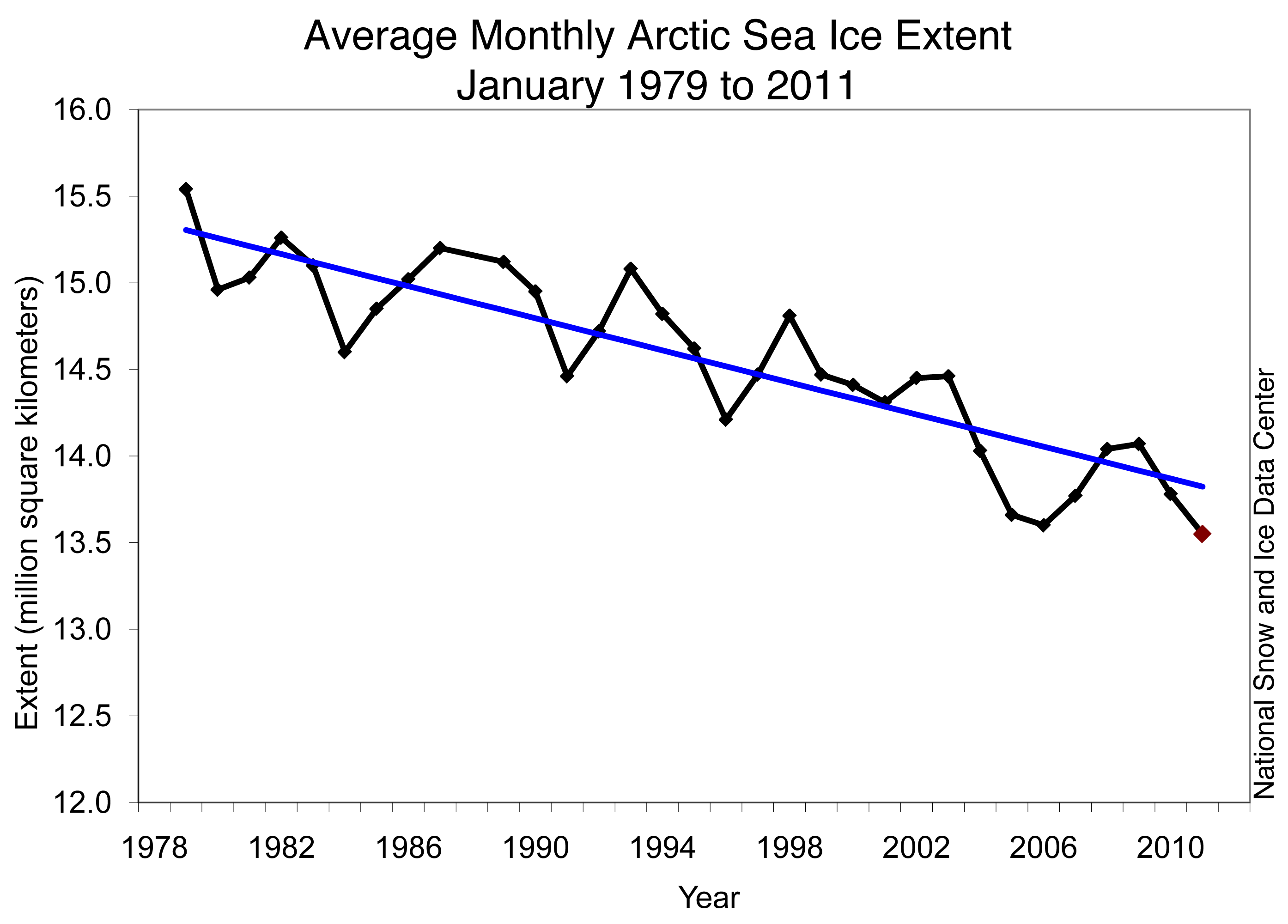
 As we shiver here in the Northeast, it is common to hear comments that embed two major misconceptions - comments like "whatever happened to global warming?" There are two things wrong with these statements:
1. Weather does not equal climate
2. The United States does not equal the world.
Although we have had unusually cold winter weather over much of the lower 48 states this year, the Arctic has been having yet more unusually warm weather. One piece of evidence is the record low extent of Arctic sea ice. The graph above shows the decline in the average annual extent. To be sure, the Arctic melt-off is much more severe in summer than in winter and these data points are year-long averages that incorporate summer extent, but there is still a clear trend consistent with significant warming of the Arctic.
This winter's weather in the Eastern US is most likely due to the North Atlantic Oscillation - a periodic rearrangement of the dominant weather systems - high latitude high pressure and mid-latitude low pressure - that changes the storm tracks across the northeastern United States and parts of Europe as well. The NAO is similar to its cousin ENSO, the El Nino Southern Oscillation. It seems to be that El Nino and NAO are not linked, although both have profound hemispheric, even global, impacts. Although the deeper causes of the NAO are not yet well understood, there is growing understanding of how to predict it and what the resulting effects on the local weather will be. What is also not known is the extent to which additions of fossil fuel carbon dioxide and the resulting warming may create a feedback with the NAO. Although we are currently in a negative NAO, it has been unusually positive for most of the past two decades, which is intriguing but certainly not definitive. See Professor David Stephenson's NAO page http://www1.secam.ex.ac.uk/cat/NAO for more detailed description and history.
